Architectural Column Styles A Visual History
Architectural column styles have shaped buildings for millennia, evolving from simple posts to elaborate monuments. From the sturdy Doric columns of ancient Greece to the ornate Composite designs of Rome, each style reflects the cultural and artistic values of its time. This exploration delves into the fascinating history of column styles, tracing their origins, analyzing their key characteristics, and examining their enduring influence on modern architecture.
We’ll journey through the Greek styles, examining the distinct features of Doric, Ionic, and Corinthian columns. Then, we’ll see how the Romans adapted and innovated upon these designs, creating new styles like the Composite. Finally, we’ll broaden our perspective to include other significant styles, such as Egyptian, Islamic, and Baroque, and consider their unique characteristics. The tables included will help you compare and contrast these styles easily.
Introduction to Column Styles

Source: medium.com
Columns, those vertical supports in architecture, aren’t just functional; they’re powerful symbols of culture and time. Their evolution mirrors the history of civilizations, reflecting artistic advancements and societal values. From ancient Greece to modern structures, columns have carried architectural stories and aesthetic significance. Understanding their development helps appreciate the rich heritage of design and construction.
Origins and Evolution of Architectural Columns
Columns, as structural elements, emerged in early civilizations, serving both practical and symbolic functions. Ancient civilizations, like the Egyptians, Mesopotamians, and Greeks, used columns for supporting roofs and emphasizing the grandeur of their buildings. The development of column styles saw significant advancements over centuries, with each civilization adding their unique artistic touches. Early columns were often simple, evolving into elaborate designs that reflected the growing sophistication of craftsmanship. The Greeks, in particular, developed distinct orders of columns, each with specific characteristics.
Fundamental Characteristics Distinguishing Column Styles
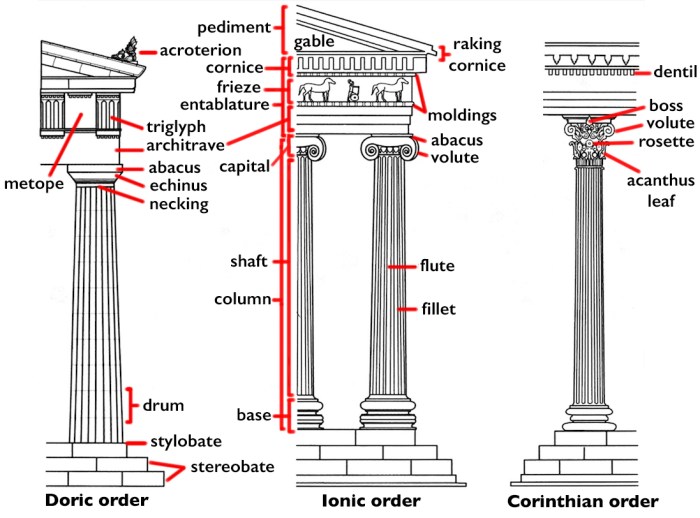
Different column styles are distinguished by specific features: the capital (the topmost part), the shaft (the vertical body), and the base (the bottom part). These elements, along with overall proportions and ornamentation, create unique visual identities for each style. The interplay of these elements defines the distinct visual language of each column style.
Cultural and Societal Influences on Column Styles, Architectural column styles
The development of column styles was deeply intertwined with the cultures and societies that created them. The Greeks, for instance, viewed columns as symbols of strength and beauty, reflecting their ideals of harmony and balance. Later, Roman architects adapted and modified Greek styles, creating new variations to suit their own needs and aesthetics. Religious beliefs, societal values, and artistic trends all influenced the choices made in designing columns, leaving behind a visible record of these influences in the architecture of the time.
Comparison of Key Column Characteristics
| Column Style | Capital | Shaft | Base | Examples |
|---|---|---|---|---|
| Doric | Simple, plain, and often square-shaped. | Straight, fluted (grooved) or unfluted, with a slightly entasis (slight bulge). | Simple and often plain. | Parthenon, Temple of Hephaestus |
| Ionic | Volutes (spiral scrolls) on either side, and a wider, more ornate form than Doric. | Fluted, taller, and more slender than Doric. | More elaborate than Doric, often with a molded base. | Erechtheion, Temple of Artemis at Ephesus |
| Corinthian | Elaborate, acanthus leaf-shaped capital, creating a more ornate look. | Fluted, taller, and slenderer than Doric and Ionic. | Elaborate and ornate, similar to Ionic. | Temple of Olympian Zeus, Choragic Monument of Lysicrates |
| Tuscan | Simple, plain, and often square-shaped, similar to Doric but without the intricate details. | Straight, unfluted, and thick, simpler than Doric and Ionic. | Simple, similar to Doric. | Roman buildings, villas |
| Composite | Combination of Ionic volutes and Corinthian acanthus leaves. | Fluted, and more ornate than other styles. | Elaborate, incorporating elements from Ionic and Corinthian. | Temple of the Dioscuri |
Greek Column Styles

Source: pickascholarship.com
The Greeks developed three distinct column orders, each with its own unique characteristics and symbolic meaning. These orders, Doric, Ionic, and Corinthian, profoundly influenced Western architecture and continue to inspire designers today. Their proportional harmony and decorative elements showcase the Greeks’ advanced understanding of aesthetics and structural engineering.
Doric Column Style
The Doric order, the earliest and most straightforward of the Greek orders, emphasizes strength and simplicity. Its capital, featuring a plain, saucer-like form, sits directly on the shaft, without a base. The shaft is fluted, with vertical grooves, and the entablature, the horizontal structure above the columns, is relatively plain.
Ionic Column Style
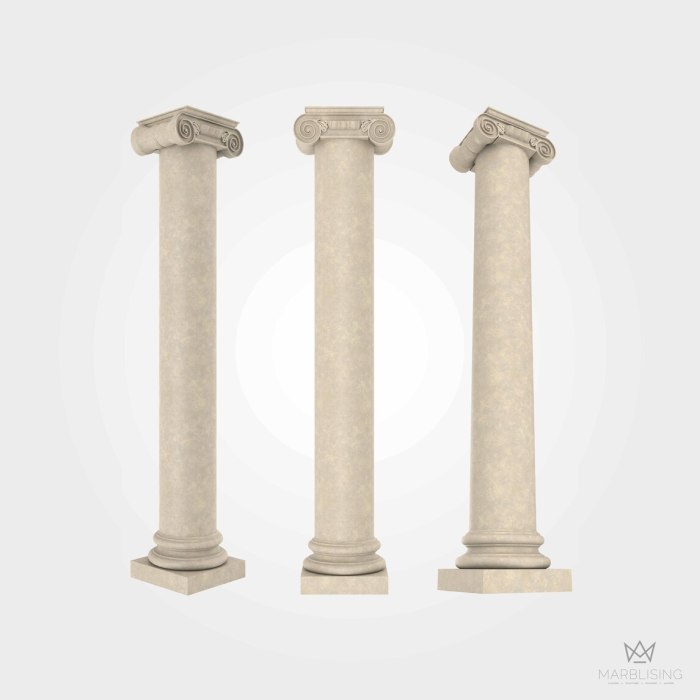
The Ionic order, appearing later than the Doric, introduced a more elaborate and elegant aesthetic. Its capital features a scroll-like design (volutes) on each side, giving it a more ornate look. The shaft is fluted, and a base separates the column from the stylobate (the platform on which the columns rest). This characteristic adds a visual break and enhances the overall elegance of the style.
Corinthian Column Style
The Corinthian order, the most ornate of the three, is characterized by its elaborate capital adorned with acanthus leaves. The acanthus leaves form a bell-shaped structure above the column’s shaft, and a base is present. This style conveys a sense of grace and richness, often used in more elaborate or monumental structures.
Evolution and Variations Within Each Style
While the basic forms of Doric, Ionic, and Corinthian columns remained relatively consistent, regional variations and stylistic evolution occurred. For instance, the proportions of the columns, the details of the capitals, and the complexity of the entablature varied slightly depending on the specific city-state or period. These subtle variations demonstrate the adaptability and creative spirit of Greek architects.
Examples of Buildings Utilizing These Styles
Numerous ancient Greek temples and structures showcase these styles. The Parthenon, a prime example of Doric architecture, stands as a testament to the order’s strength and symmetry. The Temple of Athena Nike, with its Ionic columns, highlights the grace and elegance of that style. The Temple of Apollo at Bassae demonstrates the adaptability and creative variations within each style. These examples offer a tangible understanding of the aesthetic choices and architectural achievements of the ancient Greeks.
Comparison of Column Styles
| Column Style | Key Feature 1 | Key Feature 2 | Key Feature 3 |
|---|---|---|---|
| Doric | Plain, saucer-like capital | Unfluted or slightly fluted shaft | Directly on stylobate, no base |
| Ionic | Capital with volutes (scrolls) | Fluted shaft | Base separates column from stylobate |
| Corinthian | Elaborate capital with acanthus leaves | Fluted shaft | Base present, highly ornate |
Roman Column Styles

Source: windowsreport.com
The Romans, masters of engineering and empire-building, took the Greek column styles and adapted them to their own needs and aesthetic sensibilities. They refined the forms, added their own innovations, and integrated columns into a broader architectural vocabulary that emphasized both grandeur and practicality. This approach shaped the look of countless structures across the Roman world, from grand temples to utilitarian aqueducts.
Roman architects weren’t just copying; they were evolving the column styles, developing new forms, and utilizing them in innovative ways. They also incorporated columns into their city planning, using them to create monumental gateways and public spaces.
Roman Adaptations of Greek Styles
Roman architects, while respecting the elegance of Greek forms, altered Greek column styles to suit their own aesthetic preferences and practical needs. They adjusted proportions, introduced new decorative elements, and sometimes combined Greek elements in innovative ways. This blending resulted in distinct Roman interpretations of the Greek orders. For instance, the Roman Doric column, while retaining the basic Greek proportions, often featured a more robust capital and a slightly different base.
Development of the Composite Column
The Composite column, a unique Roman creation, stands as a testament to their ability to synthesize architectural elements. It combined the volutes of the Ionic capital with the acanthus leaves of the Corinthian capital, creating a richer, more ornate design. This innovative combination reflected Roman taste for elaborate ornamentation.
Use of Columns in Roman Architecture
Columns were integral to Roman architecture, fulfilling both structural and decorative roles. They supported the weight of structures like temples, basilicas, and aqueducts, contributing to the overall stability of the building. Beyond their structural function, columns served as powerful visual elements, enhancing the scale and grandeur of Roman buildings, signifying power and status.
Comparison of Roman and Greek Columns
Roman columns often differed from their Greek counterparts in proportions and decorative elements. Roman columns were frequently more robust and less slender than their Greek counterparts, and their capitals and bases were often more elaborate and varied. Roman architects frequently experimented with different proportions and decorative elements, adding their own touch to the Greek traditions.
Examples of Buildings Incorporating Roman Column Styles
Numerous Roman buildings exemplify the use of column styles. The Colosseum, with its massive colonnades, showcases the use of columns for both support and decoration. The Pantheon, famous for its monumental dome, demonstrates the structural prowess and decorative elegance of Roman columnar systems. These structures, and countless others, demonstrate the versatility and impact of Roman column styles on the architectural landscape of the time.
Distinguishing Roman and Greek Column Styles
| Style | Greek Influence | Roman Innovation | Examples |
|---|---|---|---|
| Roman Doric | Doric proportions | More robust capital, variations in base | Colosseum |
| Roman Ionic | Ionic volutes | Elaborate bases, fluted shafts | Temple of Fortuna Virilis |
| Composite | Ionic volutes, Corinthian acanthus | Unique blend of elements | Arch of Titus |
Other Styles and Influences

Source: networkbuildz.com
Beyond the classical Greek and Roman orders, a vast array of column styles emerged, reflecting diverse cultural and historical contexts. These styles, while often drawing inspiration from nature or local materials, developed unique characteristics and aesthetic sensibilities. Understanding these non-classical styles provides a richer appreciation for the global evolution of architectural design.
Egyptian Column Styles
Egyptian columns, predating the Greek and Roman orders, showcase a distinctive approach to design. These columns often incorporate symbolic representations, reflecting the profound religious and philosophical beliefs of ancient Egyptian society. Their forms are frequently derived from natural elements like papyrus plants, lotus flowers, and palm trees, giving them a highly stylized appearance. The use of hieroglyphs and other decorative elements further enriched their visual impact. Massive scale and intricate carvings are also key characteristics of these columns.
Islamic Column Styles
Islamic architecture, flourishing across vast regions, developed a unique column style that often differed from its classical predecessors. A significant feature of Islamic column design is the incorporation of geometric patterns and arabesque designs, often carved into the stone or applied as surface ornamentation. The emphasis on intricate detailing contrasts with the simpler forms of classical orders. Furthermore, the use of pointed arches and the prevalence of open spaces in mosques and other structures further contributed to the visual character of Islamic columns.
Baroque Column Styles
Baroque architecture, a style characterized by dramatic ornamentation and grandeur, introduced distinct column styles that diverged significantly from classical models. Baroque columns often feature elaborate capitals, with swirling patterns and sculptural details, creating a dynamic and exuberant aesthetic. This embellishment, along with the use of rich materials and bold color schemes, contributed to the opulent and theatrical character of Baroque structures. The focus on drama and movement in Baroque architecture is reflected in the design of its columns.
Comparison of Non-Classical Styles
| Style | Origin | Key Features | Examples |
|---|---|---|---|
| Egyptian | Ancient Egypt | Stylized representations of plants (papyrus, lotus, palm), hieroglyphs, massive scale, intricate carvings | Temple of Karnak, Mortuary Temple of Hatshepsut |
| Islamic | Various regions across the Islamic world | Geometric patterns, arabesque designs, pointed arches, open spaces, intricate detailing | Mosque of Cordoba, Alhambra Palace |
| Baroque | Europe | Elaborate capitals, swirling patterns, sculptural details, rich materials, bold colors, dynamic and theatrical | St. Peter’s Basilica, Palace of Versailles |
Column Styles in Modern Architecture

Source: windowsreport.com
Modern architects aren’t starting from scratch; they’re drawing inspiration from the past. Historical column styles, with their elegant proportions and symbolic weight, continue to exert a powerful influence on contemporary design. This isn’t a mere imitation, but a thoughtful reinterpretation, adapting these classical forms to suit modern materials, construction techniques, and aesthetic sensibilities.
Influence of Historical Styles on Modern Design
Classical column orders, like Doric, Ionic, and Corinthian, have deeply rooted cultural significance. Their presence evokes a sense of permanence, strength, and even grandeur. Modern architects often incorporate these elements to convey a specific message about a building’s function or purpose. For instance, a building designed for a government institution might employ columns to suggest authority and stability. Similarly, a contemporary residential structure could use subtle references to historical styles to create a sense of timeless elegance.
Adaptations and Reinterpretations of Classical Styles
Contemporary architects aren’t simply copying classical designs. Instead, they adapt and reinterpret these styles. They might alter the proportions of columns, modify their capitals, or incorporate them into non-traditional layouts. This flexibility allows them to infuse a sense of modernity while retaining the visual appeal and cultural associations of the original styles. For example, a modern building might use columns in an asymmetrical arrangement, creating a dynamic and unexpected effect, or employ a different material like polished concrete to create a sense of contemporary sophistication.
Examples of Buildings Employing Modern Interpretations
Numerous modern buildings showcase adaptations of classical column styles. The design of the contemporary headquarters for a global corporation might incorporate columns in a minimalist aesthetic, using sleek, metallic materials. A museum could employ columns that subtly echo ancient Greek styles but with a contemporary, open floor plan, emphasizing transparency and functionality. These examples highlight how modern architects aren’t just reviving historical forms; they’re breathing new life into them.
Impact of Contemporary Materials and Construction Methods
Modern materials and construction techniques significantly influence column design. Reinforced concrete, steel, and advanced composite materials allow for greater flexibility and structural efficiency, enabling architects to create columns with novel shapes and sizes. The use of glass and other transparent materials allows for light to permeate the structure, altering the relationship between the interior and exterior spaces. These innovations offer new opportunities for interpreting classical forms, making them relevant to modern needs.
Continued Relevance of Column Styles
Column styles aren’t just relics of the past; they remain relevant in contemporary architecture. Their visual appeal, inherent symbolism, and potential for structural innovation continue to inspire and guide architects. The timeless elegance of columns can evoke a sense of heritage and stability in a rapidly changing world.
Contrasting Classical and Modern Interpretations
| Style | Classical | Modern Adaptation | Examples |
|---|---|---|---|
| Doric | Massive, sturdy columns; simple, unadorned capitals. | Sleek, reinforced concrete Doric columns; integrated into contemporary facades with minimal embellishments. | Contemporary corporate headquarters, government buildings. |
| Ionic | Elegant columns with volutes on the capitals; intricate detailing. | Ionic columns with streamlined volutes; integrated into open-plan spaces, showcasing light and airy aesthetics. | Modern museums, high-end residential structures. |
Column Styles and Decoration

Source: discourse-cdn.com
Column decoration isn’t just about aesthetics; it’s a powerful language, communicating cultural values, artistic trends, and the stories of civilizations. From the simple elegance of the Doric capital to the elaborate volutes of the Ionic, each element tells a tale. These decorative elements, like capitals and bases, aren’t merely embellishments; they are integral parts of the column’s design, contributing to its overall effect and meaning.
Role of Decorative Elements
Decorative elements on columns are not merely for visual appeal. Capitals, the topmost part of the column, and bases, the bottom, are essential structural components. They transition the load from the column to the entablature (the horizontal structure above the columns) and the ground, respectively. Furthermore, the intricate designs and forms of these elements carry significant symbolic and cultural weight.
Symbolism and Meaning in Decoration
The patterns and motifs used in column decoration often held specific symbolic meanings. For instance, the acanthus leaves frequently found on Corinthian capitals represent growth, abundance, and even the passage of time. These symbols, in turn, reflected the beliefs and values of the societies that created these architectural marvels. The decorative elements of a building’s columns conveyed a sense of status, power, and cultural identity.
Examples of Elaborate Decorations
The Doric order, renowned for its simplicity, often featured plain, unadorned capitals, reflecting a focus on strength and stability. In contrast, the Ionic order boasted elaborate volutes, spiral scrolls that evoked a sense of movement and elegance, mirroring the sophistication of the Greek culture. The Corinthian order, with its acanthus leaf capitals, offered a visually rich and exuberant style, signifying luxury and refinement. Roman variations, like the Composite order, combined elements from both the Ionic and Corinthian orders, showcasing a desire for a blend of elegance and strength.
Reflection of Cultural Values and Artistic Trends
Column decoration served as a visual expression of the prevailing cultural values and artistic trends of the time. The choice of materials, the intricacy of the designs, and the use of symbols all communicated a specific message about the society that commissioned the building. For example, the shift from plain Doric to ornate Corinthian capitals might reflect a societal transition from a more austere to a more opulent aesthetic.
Evolution of Column Decoration
The evolution of column decoration is a testament to the ongoing interplay between cultural values, artistic innovation, and structural needs. Early Greek orders, like the Doric, emphasized simplicity and strength, whereas later styles, such as the Corinthian, showcased increasing complexity and ornamentation. This progression mirrored the development of Greek civilization itself, reflecting its evolving social and artistic landscape. Later Roman adaptations and innovations further built on these trends.
Table of Decorative Elements
| Style | Capital Decoration | Base Decoration | Overall Effect |
|---|---|---|---|
| Doric | Plain, square capital with a simple echinus (a convex molding) | Simple, often plain or with a small plinth | Strong, stable, and austere |
| Ionic | Capital with volutes (spiral scrolls) and a relatively narrow, flat abacus (the top surface of the capital) | Base with two or more toruses (rounded moldings) and a fillet (a narrow band) | Elegant, graceful, and refined |
Final Thoughts: Architectural Column Styles

Source: insided.com
In conclusion, architectural column styles are a testament to human creativity and cultural expression across history. From the ancient world to the present day, these styles have continually inspired architects and designers. Their enduring appeal lies in their ability to communicate both structure and aesthetics. We’ve explored the evolution of column styles, from their origins to their modern interpretations, highlighting their enduring relevance in shaping the built environment. Whether you’re a seasoned architect or a curious enthusiast, this overview provides a rich understanding of this essential element of design.